
Russia expends personnel to secure terrain that does not alter the war’s direction. Claims of steady advance rely on presentation rather than outcomes. The gap between rhetoric and battlefield reality continues to widen. 10X
Full-scale invasion and national resilience, broadcasted live.
-
Mobilization failed to produce gains; Ukrainian defenses held all cities
Mobilization was meant to translate into decisive gains. Ukrainian defenses, despite supply pressure and political uncertainty among partners, held every major urban center. 9/
-
Russia’s 2025 campaign cost structure worsens with higher losses for smaller gains
The cost structure of the campaign worsened. In 2025 Russia committed larger manpower reserves for smaller territorial shifts than in 2024. Losses increased while strategic impact declined. 7/
-
Pokrovsk and Myrnohrad: Russian capture claims contradicted by reality
Pokrovsk and Myrnohrad illustrate the pattern. Russian officials announced the fall of Pokrovsk. Ukrainian units remain in position. Myrnohrad continues to be contested despite being presented as an imminent capture. 5/
-
Ukraine front lines: Vovchansk unstable, Sumy no effect, Zaporizhzhia gradual
Similar claims appear elsewhere. Vovchansk remains unstable despite being labeled “liberated.” On the Sumy axis, advertised advances produced no strategic effect. In Zaporizhzhia, progress stayed gradual and localized. 6/
-
Russia’s 2025: No Captured Cities, No Breakthrough
Key outcomes define the year more clearly. Russia did not capture a single large or medium-sized city in 2025. It did not take a major transportation hub. It did not achieve an operational breakthrough. 4/
-
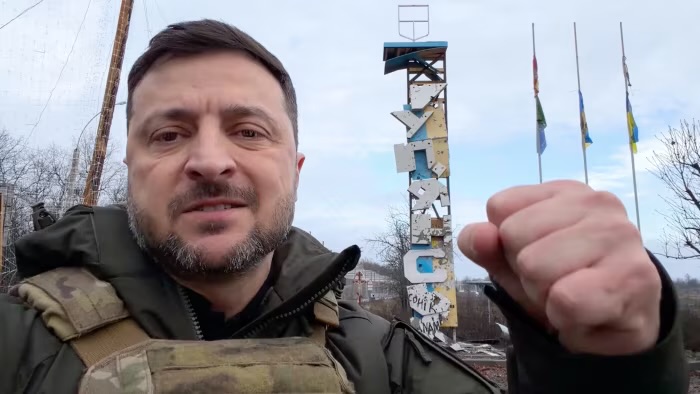
Russian victories claims contradicted by Zelenskyy’s Kupyansk visit
Russia reports battlefield victories. The front line shows a different picture. This week Zelenskyy appeared in Kupyansk, despite Moscow’s earlier claims that the city had been taken. Yevhenii Malik, who now works at the KSE, writes in WSJ. 1/
-
Pressions lors des pourparlers de paix à Berlin
The pressure comes amid US-led peace talks in Berlin. Progress was reported on security guarantees for Ukraine, but core disputes remain: Donbas territory, frozen Russian assets, and control of the Zaporizhzhia nuclear plant. 4/
-
Sanctions crushed Russia’s oil revenues, economy strained
Sanctions since 2022 have not stopped the war, but they have crushed Russia’s oil revenues. Russian crude trades at deep discounts, Brent is down 20% this year and Moscow’s economy is under growing strain. 3/
-

Trump plans sanctions on Russia energy sector if Putin rejects deal
Trump is preparing new sanctions on Russia’s energy sector if Vladimir Putin rejects a peace deal with Ukraine, according to people familiar with the plans. Targets include Russia’s shadow fleet of oil tankers and the traders who move its crude. — Bloomberg 1/