
35/ More trucks are vital, and here I am pleased with the recent news of truck deliveries (from Germany, Belgium and the U.S.). When we look at Bakhmut's supply routes, we see a bunch of civilian cars there. They don't carry much cargo, but they congest the roads. We need trucks.
Full-scale invasion and national resilience, broadcasted live.
-
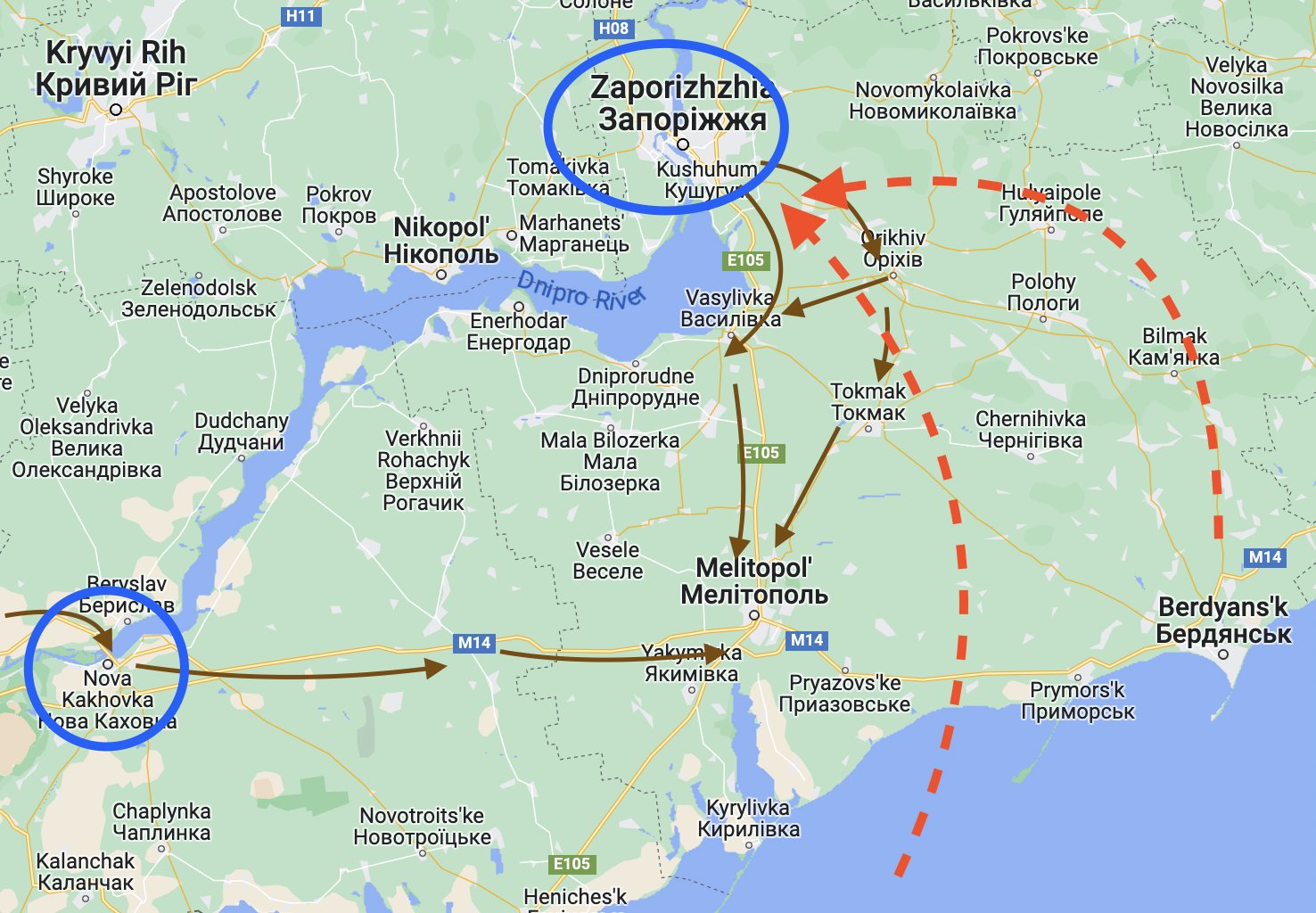
Importance of quickly occupying the Nova Kakhovka bridge
34/ However, this can become a vulnerability, as Russian aviation and artillery will attack the only route. Therefore, it is important to occupy and use the crossing at Nova Kakhovka as soon as possible.
-
HIMARS and artillery to compensate for air strikes, M777 mobility key.
31/ HIMARS strikes (which are well within range) and the active use of barrel artillery will have to compensate for aerial bombing. By the way, the lightness and mobility of the M777s will play well here – the guns clearly have to move quickly near the front.
-
Rural logistics to control routes
It's not guaranteed that you can quickly gain control of the main highways, which means you'll have to establish logistics along rural roads and even fields. A small advantage is the nearby city of Zaporizhzhia, as all the cargo will flow out from there.
-
Strategy to encircle Melitopol
If the breakthrough on the eastern bank of the Molchnaya River goes well, you can try to take Voznesenka and Kostyantynivka to completely surround Melitopol.
-
Liberating Tokmak and Melitopol: Challenges and Russian Troop Expectations
24/ Two large cities Tokmak and Melitopol – how to liberate them? It is possible that the Russian troops themselves will quickly flee the cities, but one cannot count on that. Especially as far as Melitopol is concerned.
-
Russian GMZ-3 Mines in Ukraine
20/ Remember Vuhledar, where it was mines that initially stopped the convoy. This is how the Russian army automatically lays mines using the GMZ-3 system. It ploughs the field and automatically shoves mines in the ground.pic.twitter.com/r1NX6C1rCG
— ChrisO_wiki (@ChrisO_wiki) 1 mai 202320/ Remember Vuhledar, where it was mines that initially stopped the convoy. This is how the Russian army automatically lays mines using the GMZ-3 system. It ploughs the field and automatically shoves mines into the ground.
-
Invisible minefields test Ukrainian forces’ limited time and effort.
21/ The minefield has another sneaky trait – you can't see it. It's an invisible enemy that you have to reckon with and check everything and everywhere. It takes effort and time. The very thing the AFU has very little of.
-
AFU’s tech edge in tank duels
18/ Open terrain welcomes long-range tank duels and ATGM warfare. But here the technological advantage lies with the AFU, so all that remains is to find buried and camouflaged firing points and the tanks of Putin's army. pic.twitter.com/4y9VJweRpl
— ChrisO_wiki (@ChrisO_wiki) 1 mai 202318/ Open terrain welcomes long-range tank duels and ATGM warfare. But here, the technological advantage lies with the AFU, leaving only the task of locating buried and camouflaged firing positions and the tanks of Putin's army.
-
AFU’s difficult moments and challenges for a successful offensive
16/ Part 7 – difficult moments In this part I will highlight and break down all the problems and challenges that the AFU will have to solve in order for the offensive to be successful or to succeed at all. We must not forget that this entire operation is incredibly complex.