
Their locations should be clarified by Ukrainian intelligence, but it is unlikely that they are confined to Crimea.
Full-scale invasion and national resilience, broadcasted live.
-
Crimean Canal Bridges: Strategic Targets
Destroying these bridges could cut off the grouping at the mouth of the Dnipro from normal communications with the front. This would be useful, including during the third phase of the offensive (more on this later).
-
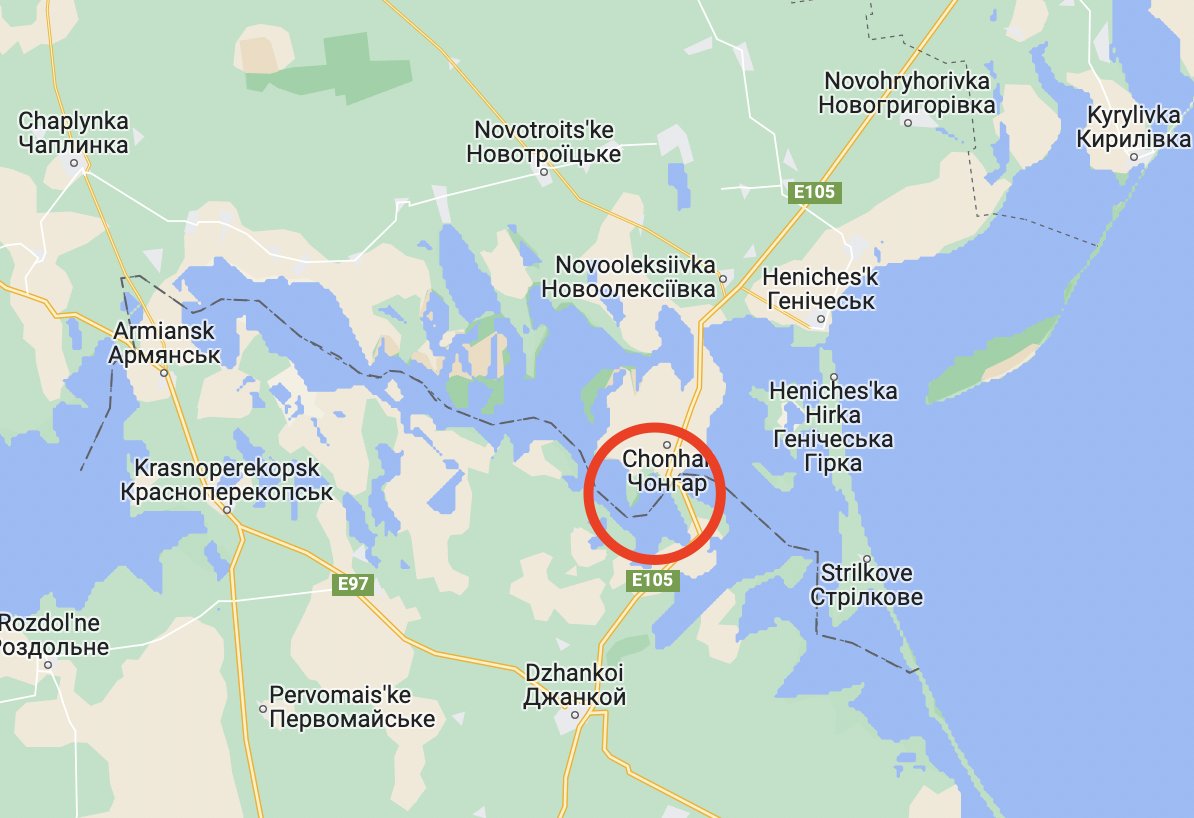
Bridges near Chonhar and Syvash damaged
Difficult targets, also due to their distance and the bridges' structural strength. However, if they are damaged—even temporarily—it could disrupt the overall balance of military supplies, some of which likely pass through Crimea.
-
Volnovakha railway junction
This is the starting point for the railway leading west, roughly in the middle of the occupied territory. It is also crucial for supply and troop movements.
-

Dzhankoi railway junction: a vital transport hub connecting Crimea to mainland Ukraine
43/ Dzhankoi railway junction Here everything is obvious. Not only does the railway run through this junction to the west – to Sevastopol, but also to the north through Chonhar to Melitopol. In fact, Dzhankoi is the second Crimean bridge.
-
Ammunition depots and bombing impact
It is the same with ammunition depots. If bombed in advance, of course new structures will eventually be brought in. But there will be no more left where they are brought from. Besides, when the front is calm, things can be prioritised.
-

Analysis of defensive lines on the map
On the overall map, we can draw several conclusions: 1. There are two main lines of defence, located close to each other (from 16 to 4.5 km). 2. The Mykhailivka-Mala Bilozerka area is the most heavily covered.
-
Use of mines in defense despite foolish positions
In some places they will just bypass them. Some positions are in blatantly dumb places. But they can still give some benefit to the defence, including through the use of mines.
-
Questions sur l’équipement et les réserves des troupes
28/ The combat effectiveness and equipment of these troops raises big questions. All the reserves go to other directions, probably here there is a shortage of modern tanks (T-62s were brought to this section of the front) and ammunition.
-
Russian military units: 64th Motorised Rifle, 11th Airborne, 45th Special Forces, DPR/LPR, Wagner
25/ Other powerful Russian units include the 64th Motorised Rifle Brigade, the 11th Airborne Assault Brigade and the 45th Special Forces Brigade. As well as a fairly large contingent from the Luhansk and Donetsk 'Democratic Republics' and even probably Wagner.